
April 4, 1840 - Dec 4, 1841
Weekly journal written entirely by Dickens. The premise of the journal was
that Master Humphrey, along with friends, gathered weekly to read stories
which were stored in Master Humphrey's old grandfather clock. Some original
sketches brought back characters from Pickwick.
After initial success, sales slumped and Dickens introduced The
Old Curiosity Shop, the serialization of which took over the entire
publication, sales skyrocketed, reaching 100,000 weekly. The novel begins
with Master Humphrey as narrator but as the story continues he mysteriously
disappears, reappearing briefly at the end of the novel. Barnaby
Rudge was also published in Master Humphrey's Clock.
|
 |
 |

American Notes
| Pictures From Italy | The Life
of Our Lord | A Child's History of England
Weekly Magazines
- 1843
Read
it online | Buy
it at Amazon.com
Chronicle of Dickens' first American visit
in 1842. Written largely from letters that Dickens sent home to his
friend John Forster, American
Notes sold well but received negative reviews on both sides of
the Atlantic. American readers were put off by Dickens' criticism
of the American press, American manners, slavery, and his preoccupation
with international copyright laws. English readers saw nothing novel
in his matter-of-fact observations. Today American Notes offers
an interesting glimpse of an America experiencing the growing pains
that would eventually lead to civil war. Many of Dickens' observations
of the time are hilariously quaint today, particularly his view of
the American habit of tobacco chewing.
|
- 1846
Read
it online | Buy
it at Amazon.com
Dickens, his wife Kate, her sister Georgina, and the Dickens' five
children, along with several servants, left London in a very large
coach on July 2, 1844 bound for Italy. Dickens had employed Louis
Roche, whom he referred to as "the brave courier" to be their guide
and make travel arrangements. Louis was a native of Avignon and proved
to be invaluable.
On the advice of a friend Dickens had rented a house outside Genoa
in Albaro which proved to be unsatisfactory. After three months the
family moved to Genoa and into the beautiful Palazzo Peschiere. Dickens
became enchanted with Genoa and the manner of the people which he
described as "exceedingly
animated and pantomimic; so that two friends of the lower class conversing
pleasantly in the street, always seem on the eve of stabbing each
other forthwith. And a stranger is immensely astonished at their not
doing it."
Early during their one-year stay in Genoa Dickens wrote the Christmas
book The Chimes, getting the idea for the title from the
incessant ringing of bells in Genoa. On completion of the book he
dashed back to England, by way of Venice, Milan (where he reported
that clumsy attempts by 'bunglers' to patch Da Vinci's The Last Supper
had virtually destroyed it), and Switzerland, to read it to friends.
He returned to his family in Genoa just before Christmas 1844.
Early in 1845 Dickens and Kate left the children with Georgina and
traveled through southern Italy visiting Pisa with its leaning tower
("like most things connected in their first associations with school-books
and school-times, it was too small"). Initially disappointed with
Rome, which he reported looking, at a distance, like London, he was
soon captivated by the ruins. He reported to his friend John Forster
that he had never in his life been so moved or overcome by any sight
as by that of the Coliseum, except perhaps by the Falls of Niagara.
They visited the ruins of Herculaneum and Pompeii, made a very dangerous
trip to the top of Vesuvius, even climbing to the very rim and peering
into the "Hell of boiling fire below" and coming away with his clothes
alight in a dozen places.
Coming back to Rome to observe Pope Gregory XVI conduct Holy Week,
Dickens could not hide his disdain for the Catholic Church whose empty
rituals seem to him a farce, and whose power he blamed for the oppression
and poverty of the people. This anti-Catholic slant found its way
into Pictures From Italy to the point that his friend, artist
Clarkson Stanfield, who had agreed to illustrate the book, later refused.
The family returned from Italy in June of 1845. Dickens used the letters
to his friend John Forster during the trip to compile Pictures
From Italy.
Map of Dickens' travels
1844-45
|
- written 1846, published 1934
Read
it online | Buy
it at Amazon.com
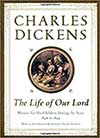
Dickens wrote The Children's New Testament, a simplified version
of the life of Christ, for the instruction of his children and was
never meant for publication. With the death of Dickens' last surviving
child, Henry Fielding Dickens, in 1933, the rights to the work were
sold to the Daily Mail and published with the new title The
Life of Our Lord.
|
- Published serially in Household
Words from Jan 1851 to Dec 1853
Read it
online | Buy
it at Amazon.com
Dickens' history of England from the Roman conquest in 55 BC to the
Glorious Revolution of 1688 when Protestant William of Orange wrested
the throne from Catholic James II. Written for children with a decidedly
Protestant slant, Dickens, no historian himself, relied on previously
written histories including Thomas Keightley's History of England
and David Hume's History of Great Britain.
|
Mar 30, 1850 - May 28, 1859
Weekly magazine which Dickens edited along with sub-editor W. H. Wills. Charles' father, John Dickens, also had editorial duties on the magazine. Dickens received a salary and additional payments for his own contributions. The weekly contained topical journalism, essays, short fiction, and poetry by a total of 380 contributors. It was published every Wednesday at a cost of twopence and consisted of 24 pages of double columns without illustration. The magazine proved a financial success with sales reaching 100,000 weekly. Although serial publication was not planned for the journal, Dickens published his novel Hard Times in Household Words in order to bolster sales during a period of reduced profit. Dickens' total contribution to the weekly included 108 full-length essays and articles, co-writing another 45. After quarreling with his publisher, Bradbury and Evans, Dickens discontinued Household Words and the journal was incorporated into a new weekly, All the Year Round. 31 of the articles Dickens wrote for Household Words were published as Reprinted Pieces in 1858.
|
April 30, 1859 - 1893
Dickens' successor to Household Words took the same format
as its predecessor. Dickens contributed less material to All the
Year Round than he had for Household Words, although he
did serialize A Tale of Two Cities
and Great Expectations in the
weekly. Dickens owned 75% of the venture and served as editor until
his death in 1870 at which time his son Charley took over as editor
until 1888. The magazine ceased publication in 1893. A collection
of the sketches Dickens wrote for All the Year Round were later
published as The Uncommercial Traveller.
Cover of the November 3,
1860 edition of All The Year Round
(193k jpg file)
|

|
 |
 |
|