
 Discovering Dickens

Reading Charles Dickens
Tips for reading Charles Dickens along with some short selections from his work
Reading Dickens: Tips and Tools
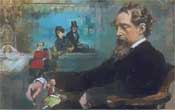
In the nineteenth century everyone, from Queen Victoria to the street sweepers, either read Charles Dickens or had Dickens read to them. Reading Dickens today is more of a challenge as many of the words he used, and the things those words described, have fallen out of common use. Having a good reference handy while you're reading will ensure that reading Dickens today will be just as entertaining as it was 150 years ago. After all, they're not classics because they're old...but because they're great!
Many good Dickens references are available, I like Charles Dickens A to Z : The Essential Reference to His Life & Work by Paul Davis and The Oxford Reader's Companion to Dickens, edited by Paul Schlicke.
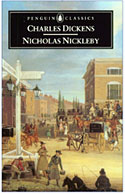
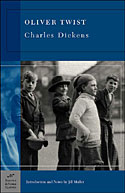
Also very good are two paperback editions of Dickens' works: Penguin Classics, which include the original illustrations along with very helpful notes within the text, and the inexpensive Barnes & Noble Classics, which include endnotes, comments, and questions. Michael Patrick Hearn's The Annotated Christmas Carol is a wonderful way to enjoy Dickens' timeless Christmas classic.
A Good Place to Start
Want to be exposed to Dickens but are intimidated by the 900 page tomes he was famous for? Start with one of these short stories, sketches, magazine articles, and excerpts of his works that can be read in a single sitting.
Early Sketches
 |
A Christmas Dinner - Early Dickens
Christmas story describes a Christmas dinner at the home of Uncle and Aunt George. Originally published in Bell's Life in London in 1835 under the name Scenes and Characters No. 10 Christmas Festivities. |
 |
The New Year - Dickens describes a party on New Year's Eve 1835. Published in Bell's Life in London as Scenes and Characters No 11. |
 |
Omnibuses - Dickens' hilarious account of riding in a London omnibus. The omnibus, a relatively new concept of mass transit, was replacing the coach as a means of moving about the city. Originally appeared as Street Sketches No. 1 in the Morning Chronicle September 26, 1834. |
 |
Seven Dials - Sketch describing this notorious London slum, so named for the seven streets that come together there. Dickens observes the residents there living in squalor and filth. Originally published as Scenes and Characters No. 1 in Bell's Life in London in September 1835. |
 |
The Pawnbroker's Shop - Dickens describes
a pawnbroker's shop in Drury Lane and the customers who are forced, through poverty, to deal there. Published as Sketches of London No. 35 in the Evening Standard in June 1835. |
 |
A Visit to Newgate - Dickens visited
the notorious London prison in 1836 describing the men, women, and children imprisoned there. He also imagines what it must have been like to have been a condemned man in the last night before execution. Published in Sketches by Boz. |
 |
The Hospital Patient - Dickens relates the touching story of a young woman in a London hospital who has been brutally beaten by her husband. Police bring the husband to the hospital to observe the dying woman who refuses to identify him as the man who beat her. Originally published in The Carlton Chronicle in August 1836. |
 |
Gin Shops - Dickens describes the gin
shops in the slums of St. Giles frequented by the London poor. Originally published in The Evening Chronicle on February 19, 1835. |
 |
Mr Minns and his Cousin - Dickens' first published work, originally titled A Dinner at Poplar Walk, appeared in Monthly Magazine in December 1833. It was retitled Mr Minns and his Cousin for its inclusion in Sketches by Boz. |
 |
Coaching Inns - In one of Dickens' earliest stories he describes the excitement and bustle caused when a coach arrives at an inn. Horses are changed, passengers enjoy a brief respite, and local idlers get a few moments of excitement. Then, in a flash, it's all over. Coaching Inns began to disappear with the coming of the railroad in the 1830s. |

Magazine Articles
 |
Bill Sticking - Article written for
Dickens weekly journal Household Words published March 22, 1851 in which Dickens interviews the King of the Bill-Stickers, men
hired by contractors to paste advertisements on hoardings (rented billboards), and just about anywhere else they could get away with it. |
 |
In Memoriam W. M. Thackeray
- Dickens eulogized his friend and fellow author, William Thackeray (1811-1863), in Cornhill Magazine in February 1864 |
 |
Dullborough Town - Dickens, at
age 48, describes a trip to his childhood home of Chatham, which he refers to as Dullborough, and finds it 'mysteriously gone, like my
own youth'. First published in Dickens' weekly journal All the Year Round June 30, 1860 |
 |
Waterloo - On patrol with Thames police
officer 'Pea', Dickens is introduced to 'Waterloo', night toll-taker on Waterloo Bridge, who describes suicides and other unusual events
he has seen. Condensed from Down with the Tide, Household Words, February 1853. |
 |
Night Walks - Dickens, as the Uncommercial Traveller, can't sleep and spends his nights walking around London. His nighttime rambles take him to Newgate Prison, Covent Garden, Westminster Abbey and other locales. All the Year Round, July 21, 1860. |
 |
Captain Murderer - Dickens recalls the story of Captain Murderer, a story that his nurse would terrify him with as a child. Condensed from Nurses Stories in All the Year Round, September 8, 1860. |
 |
What Christmas Is as We Grow Older - Dickens' Christmas message in the 1851 Christmas edition of his weekly magazine, Household Words, reminds readers to remember those who have passed and to cherish their memory as part of the celebration of the holiday. Dickens himself had recently lost his father John Dickens, his infant daughter Dora, his sister Fanny, and her crippled son Henry Jr. He also remembers, as always, Catherine's sister Mary, a dear girl--almost a woman--never to be one, who died in 1837. |
 |
A Christmas Tree - Dickens' Christmas story in the 1850 Christmas edition of his weekly magazine, Household Words. As he gazes at the Christmas tree Dickens is reminded of Christmases from his childhood. |
Excerpts from Major Works
 |
David Copperfield - Chapter 11
- Contains much of the "autobiographical fragment" which Dickens gave
to his friend and biographer, John Forster, relating in the fictionalized
account of David Copperfield the story
of Dickens' own troubled childhood. |
 |
David Copperfield - Chapter 41
- Hilarious account of Copperfield and his friend Traddles' visit
to David's sweetheart Dora's spinster aunts to obtain their permission
to call on her. |
 |
Dombey and Son - The Coming of the Railroad
- Condensed from chapter 6 of Dombey and Son in which Dickens describes
the upheaval caused by the railroad's intrusion into Camden Town. |
 |
American Notes - From Pittsburgh to Cincinnati
in a Western Steamboat - During Dickens' 1842 tour of America
he describes a fascinating trip aboard the steamboat Messenger
down the Ohio river during the heyday of the American steamboat. |
 |
American Notes - The Haves...and the Have
Nots - Near the end of Dickens' 1842 travels in North America
he observed, on a steamboat between Quebec and Montreal, emigrants
from England crowded between decks. He recorded his thoughts, in this
beautiful passage in American Notes, on the burden poor families
face over those blessed with plenty. |
 |
The Pickwick Papers - Equestrian Journey to
Dingley Dell - Samuel Pickwick and his fellow travelers, Tracy
Tupman, Nathaniel Winkle, and Augustus Snodgrass, are traveling from
Rochester to their friend Mr Wardles residence at Manor Farm, Dingley
Dell, a journey of about 15 miles. The travelers' inexperience at
handling horses is evident in this comic adventure. |
 |
The Pickwick Papers - Mr Pickwick Meets the
Lady in Yellow Curl Papers - In one of the funniest episodes
in the novel, Samuel Pickwick and his servant, Sam Weller, have traveled
to Ipswich in search of the rascal Alfred Jingle, taking rooms in
the Great White Horse Inn. Mr Pickwick is ready to retire for the
night when he realizes he has left his watch on the dinner table downstairs
and determines to go and get it. |
 |
A Christmas Carol - Cratchit's Christmas
- Scrooge, accompanied by the Ghost of Christmas Present, visits the
home of his clerk, Bob Cratchit, to observe the Cratchit's simple
Christmas celebration. |
 |
Oliver Twist - Oliver asks for More -
Nine-year-old Oliver is a resident in the parish workhouse where the
boys are "issued three meals of thin gruel a day, with an onion twice
a week, and half a roll on Sundays" and has the audacity to ask for
more. |
 |
Martin Chuzzlewit - Mrs Gamp - Even among the
bizarre cast of characters in Dickens, Mrs Gamp is a piece of work.
She is a nurse of sorts whose specialty lies in the polar extremities
of life, the lying in and the laying out. |
 |
A Christmas Carol - Condensed
- Dickens pared down A Christmas Carol for his public readings.
Read an annotated version of Dickens' own reading text that can be
read in a single sitting! |
 |
Martin Chuzzlewit - An Easy Shave - Young Bailey, street smart and moving up in the world, has gone to visit his friend the barber, Poll Sweedlepipe, and has decided that his baby face could use a shave in this comic scene from Martin Chuzzlewit. |
 |
Pictures from Italy - A Beheading in Rome - During Charles Dickens' stay in Rome during his Italian travels of 1844-45 he attended the beheading of a man guilty of robbery and murder. |
 |
Pictures from Italy - The Last Supper - During Charles Dickens' travels in Italy in 1844-45 he visits the Santa Maria delle Grazie in Milan and views Leonardo da Vinci's The Last Supper. |
 |
American Notes - American Railroads 1842 - During his 1842 American trip Dickens took his first ride on an American railway on February 3 on a trip from Boston to Lowell, Massachusetts and described the state of American railroads in its infancy. |
 |
American Notes - Sailing 1842 - After a harrowing trip to America by steamship Dickens determined to return to Britain under sail. He left New York on June 7 and arrived in Liverpool on June 29. The ship, American packet sailing vessel George Washington, was built at New Bedford, Massachusetts in 1832 and regularly made the trip from New York to Liverpool. In 1845 she was converted to a whaler. In this last chapter of American Notes he describes the voyage home. |
 |
Pickwick Papers - The Goblins Who Stole a Sexton - Mr Wardle, at the Christmas Eve party at Dingley Dell, tells the story of Gabriel Grub, a morose and melancholy sexton and gravedigger in a village churchyard. Grub, an old curmudgeon at odds with the world, dreams he is visited by a host of goblins on Christmas Eve and changes his ways. The story is considered a precursor to A Christmas Carol. |